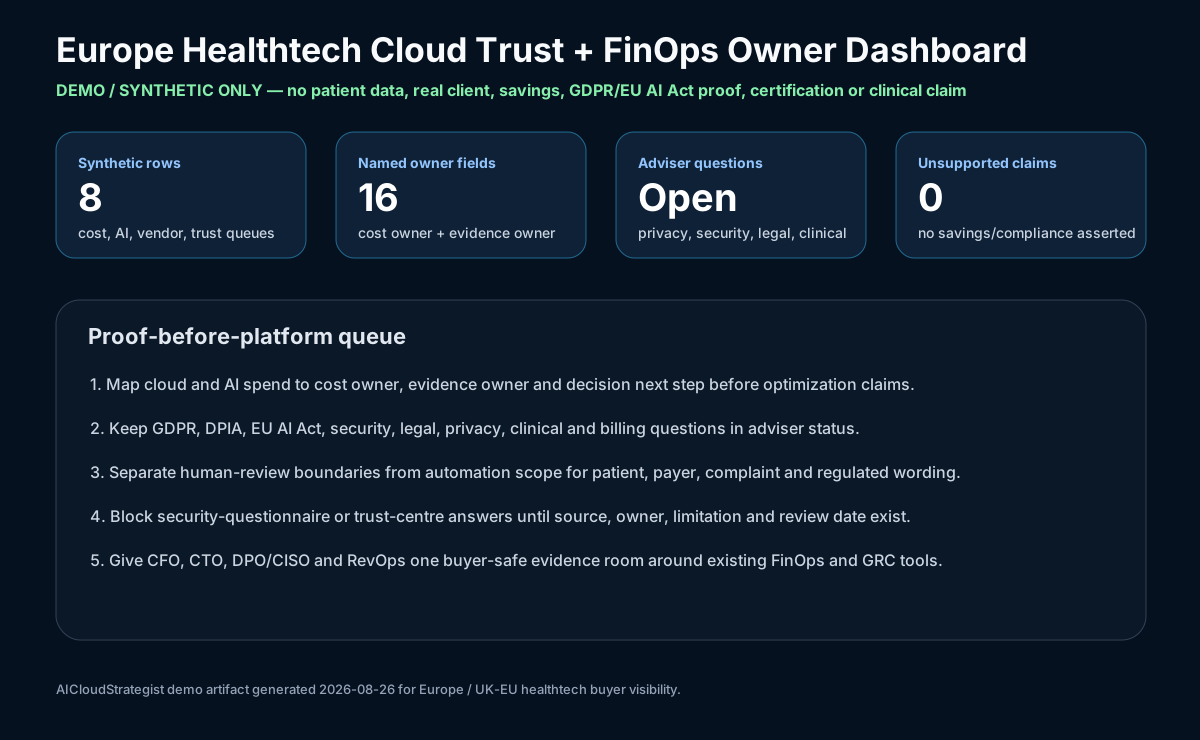
Region selected: Europe / UK-EU business day. Buyer pain-language researched: “healthtech cloud cost optimisation”, “AI cloud FinOps”, “LLM cost governance”, “GDPR evidence”, “DPIA questions”, “security questionnaire evidence”, “vendor risk management”, “trust centre evidence”, “DPA blocker”, “EU AI Act evidence”, “data residency”, “subprocessor register”, “human review” and “clinical safety boundary”.
Top competitors and alternatives buyers may already know
FinOps / cloud-cost platforms
Apptio Cloudability, VMware/CloudHealth, CloudZero, Vantage, Datadog Cloud Cost Management, AWS Cost Explorer, Azure Cost Management and Google Cloud cost tools can help teams inspect spend, allocation and usage.
GRC / trust / questionnaire platforms
Vanta, Drata, Secureframe, Sprinto, OneTrust, TrustArc, Hyperproof, Conveyor, SafeBase and Whistic can help teams manage compliance workflows, trust centres, vendor-risk evidence and questionnaire answers.
AICS top-3/top-5 consideration wedge
AICS should not present itself as another FinOps dashboard or GRC replacement. The credible wedge is proof-before-platform: assemble the cost owners, AI usage, data-flow questions, adviser routes, evidence gaps and buyer-safe answer snippets before a healthtech team buys, migrates or renews another platform.
- Publish field templates: show exact columns for cloud spend owner, AI workflow, vendor/model, data category, reviewer and evidence status.
- Show claim discipline: keep legal, GDPR, EU AI Act, medical, security, audit and certification questions marked for qualified advisers.
- Connect finance and trust: make cost allocation, AI governance and questionnaire readiness one executive action room.
- Use buyer language: cloud cost optimisation, AI spend governance, GDPR evidence, vendor risk, security questionnaire, trust centre, human review and data residency.
Synthetic evidence-room sample
All rows below are synthetic. They show evidence shape only; they do not describe a real healthtech company, clinic, hospital, patient, provider, payer, user, vendor contract, cloud bill, production system, personal data, health data, saving, compliance result or procurement outcome.
| Question buyers ask | Evidence to collect | Owner | AICS output | Boundary |
|---|---|---|---|---|
| Why did AI/cloud spend change? | AWS/Azure/GCP exports, LLM/API usage, GPU jobs, environment tags and release dates. | Finance + platform engineering | FinOps owner map with unallocated AI/cloud spend and review cadence. | No savings, ROI, margin or runway claim. |
| What patient or personal data touches AI? | Data categories, redaction notes, prompt logs where approved, retention, regions and subprocessor references. | Privacy/DPO + security | GDPR adviser-question register and data-flow evidence map. | No GDPR, DPIA, EU AI Act or medical compliance claim. |
| Can procurement trust the answers? | Security questionnaire rows, policy links, incident route, access reviews, vendor register and trust-centre evidence. | Security + RevOps | Questionnaire source-of-truth pack with owner, status and ageing. | No SOC 2, ISO 27001, HITRUST, audit or certification claim. |
| Where is human review required? | Clinical, care, billing, coverage, complaint, emergency and legal/privacy escalation routes. | Operations + accountable clinical/business owner | Human-review boundary log and unsafe-automation stop list. | No clinical, diagnosis, treatment, emergency or AI-accuracy claim. |
Diagnostic output AICS can build safely
- Cloud and AI cost-owner allocation register.
- AI usage / model / vendor dependency register with data-category and region questions.
- Security-questionnaire evidence index with missing-proof and adviser-needed labels.
- Human-review, escalation and claim-control map for clinical, medical, billing, coverage, privacy, security and complaint content.
- Executive dashboard wireframe for unowned costs, high-age evidence blockers, buyer questions and next decisions.
Europe procurement search-intent map
During this run, public source checks returned readable pages for the EU AI Act overview, ICO artificial-intelligence guidance hub, NHS Data Security and Protection Toolkit, Vanta GDPR, Drata GDPR, OneTrust AI Governance, TrustArc AI Governance, Apptio Cloudability, Datadog Cloud Cost Management, AWS Healthcare & Life Sciences, Microsoft Cloud for Healthcare and Google Cloud healthcare/life-sciences pages. UK DTAC returned HTTP 403 from this environment, so this page treats DTAC only as a buyer-language signal rather than as a verified source-detail claim.
Searches from CFO / CTO / platform teams
- healthtech cloud cost optimisation Europe
- healthcare SaaS FinOps cost allocation
- AI spend governance LLM cost owner dashboard
- cloud cost management healthcare AWS Azure GCP
- unallocated Kubernetes GPU LLM cost evidence
Searches from DPO / CISO / procurement teams
- GDPR AI data protection evidence healthtech
- EU AI Act healthtech vendor risk questions
- NHS DSPT security questionnaire evidence
- DTAC evidence checklist digital health supplier
- subprocessor data residency human review evidence
Why this improves top-3/top-5 credibility
Buyers already know hyperscaler healthcare clouds, FinOps tools and GRC/trust platforms. AICS must therefore publish concrete artefacts that answer: who owns the cost, what evidence supports the questionnaire answer, which adviser must decide the GDPR/EU AI Act/NHS question, what AI workflows are unsafe to automate, and what can be said externally without overstating proof.
Owner dashboard demo artifacts
Added 2026-08-26: a synthetic owner dashboard CSV and demo owner dashboard SVG that connect cost owner, evidence owner, adviser-question status, human-review boundary and next decision in one buyer-safe evidence-room view.
Executive owner queue
CFO, CTO, DPO/CISO, RevOps and accountable clinical/business owners can see who owns each synthetic cost, AI, data-flow, questionnaire and renewal question.
Claim-control queue
Every row stays labelled demo/synthetic and blocks unsupported savings, GDPR, EU AI Act, security certification, clinical, procurement, ranking, revenue or customer-result claims.
Use this before buying another platform
If a healthtech team cannot name the owner, evidence source and adviser route for each row, a bigger FinOps or GRC platform may only centralize uncertainty. AICS can package the action room first, then help the buyer decide what platform still matters.
Scope an evidence-room diagnosticNo-credentials first-review boundary
Added 2026-08-27: AICS now publishes a no-credentials intake policy for this evidence room. It states that the first diagnostic should use redacted exports, screenshots, questionnaire rows and owner fields by default — not cloud-console credentials, secrets, raw patient/health data, live GRC logins or unsupported compliance/savings claims.
Claim boundaries
This is public buyer education with synthetic field examples only. It is not a real European healthtech case study, not a testimonial, not production data, not customer data, not patient data, not health data, not GDPR compliance proof, not EU AI Act compliance proof, not healthcare compliance proof, not security certification, not audit advice, not DPO advice, not legal advice, not medical advice, not clinical advice, not privacy advice, not security advice, not procurement-win evidence, not savings evidence, not revenue evidence, not ROI evidence, not ranking evidence and not AI-accuracy evidence.
FAQ
What would a real diagnostic use?
Approved cloud exports, redacted invoices, tags, budgets, tickets, model/vendor lists, existing questionnaire rows, trust-centre links and owner notes. AICS should not need production credentials, secrets, private keys, patient data or health data for the first map.
Who decides compliance or clinical boundaries?
Client-appointed legal, privacy, DPO, security, audit, medical, clinical and procurement owners. AICS can organize evidence and unresolved questions; it should not make adviser decisions outside scope.
North America healthtech version · Europe SaaS evidence matrix · More resources · AI answer-engine map