Best use: CIO, CISO, CTO, platform, security, product, operations and governance teams that already have identity, access-management, ticketing, LLMOps, observability or GRC tooling, but still need a business-readable evidence packet for deciding whether an AI agent should keep, narrow, pause or lose access.
Buyer problem this catches
Search phrases and internal trigger language
- Enterprise AI agent access review checklist
- AI agent tool permission evidence
- AI agent data access governance checklist
- LLM retrieval source access review
- agent identity and service account review
- AI access revocation evidence checklist
The AICS wedge
Most access reviews stop at accounts, groups or vendor settings. AICS maps the operating evidence around the AI workflow: why the agent needs the access, which tools it can call, what it can read or write, which retrieval sources it uses, who approves exceptions, where logs live and how access is revoked when the risk changes.
Top-3 gaps to evidence before expanding AI agent access
- Tool permissions are broader than the business task. The review should connect every read, write, send, update, create, delete or external-call permission to a named workflow and accountable owner.
- Retrieval sources are treated like passive content. An AI agent can expose, summarise or combine knowledge in unexpected ways. The packet should show source owner, data class, audience, freshness and redaction boundary.
- Revocation is not operationally owned. Access is weakly controlled if nobody knows the trigger, approver, emergency stop route, monitoring signal or evidence required to remove or narrow permissions.
Downloadable artifact: use the AI agent access review evidence CSV template to turn scattered permission notes into an owner, approval, monitoring and revocation board. Rows are synthetic examples only and must be replaced with redacted, authorised facts before any real review.
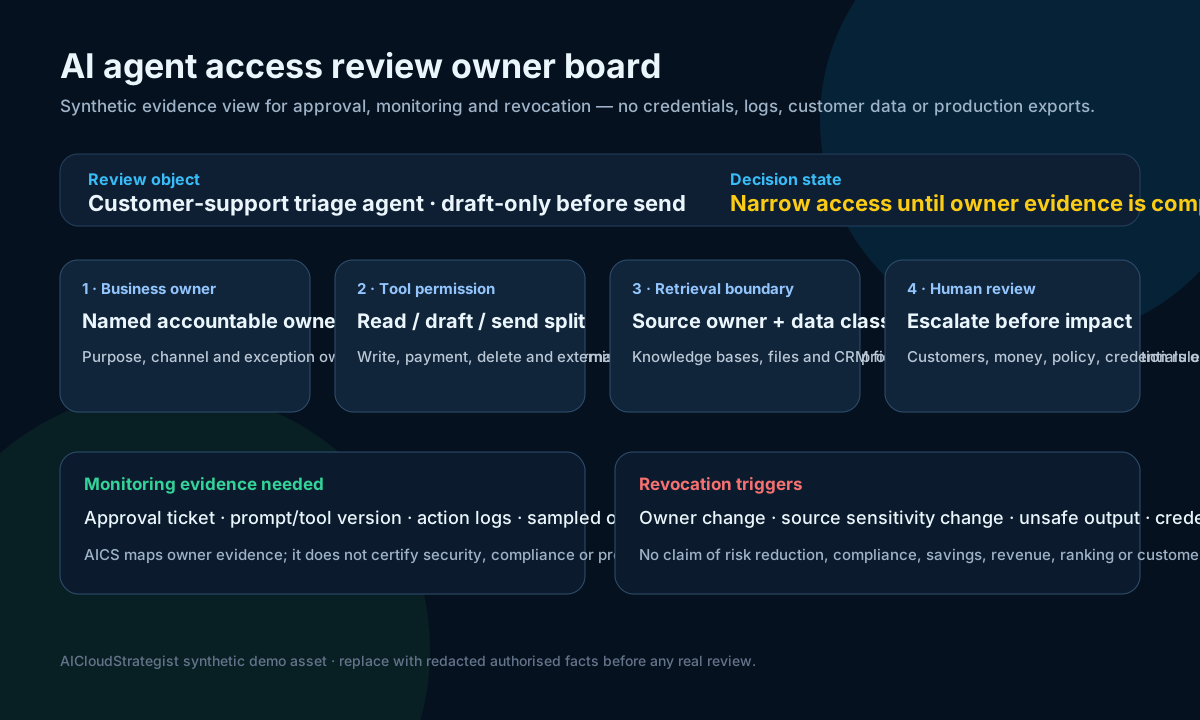
Demo AI agent access review owner board
This synthetic board helps buyers see the review shape before sharing credentials or logs: business owner, permission scope, retrieval boundary, human-review route, monitoring evidence and revocation triggers are separated from unsupported risk, compliance, savings, revenue or production-readiness claims.
Open demo access review owner board SVG
| Evidence field | Why it matters | Safe AICS handling |
|---|---|---|
| Agent identity and owner | Shows whether the agent uses a service account, vendor identity, human delegate, API key or workflow token, and who owns that access. | Map ownership and decision context; do not certify identity architecture. |
| Tool and action scope | Separates draft-only work from read, write, send, update, payment, deletion, customer-impacting or regulated actions. | Flag risky actions for qualified owner approval and human-review gates. |
| Data and retrieval boundary | Clarifies sensitive data classes, source systems, embeddings, files, customer records, internal policies and cross-border/vendor exposure questions. | Create adviser-question rows; do not provide legal or privacy opinions. |
| Human-review route | Defines when the agent drafts only, asks for approval, escalates, pauses, blocks, or requires a named human decision. | Convert hidden escalation assumptions into explicit operating rules. |
| Monitoring and revocation trigger | Shows what evidence proves access is still appropriate, and what event requires narrowing, disabling or rotating credentials. | Package owner-readable review cadence, triggers and missing-evidence list. |
5-day diagnostic package
Days 1-2: access inventory
- Map 3-5 AI agents or agent-like workflows across tools, APIs, retrieval sources, identities, permissions, tickets and approvals.
- Classify draft-only, read, write, send, update, delete, external-call and sensitive-data paths.
- Separate implementation facts from security, privacy, legal and business-owner questions.
Days 3-5: access evidence board
- Create an AI agent access review board with owner, system, permission, data class, approval status, missing evidence and next decision.
- Draft a reusable access review packet for new tools, retrieval sources and action permissions.
- Deliver a revocation route: monitor, pause, narrow, rotate credential, disable, escalate and review.
Need AI agent access reviewed before autonomy expands?
AICS can scope a fixed diagnostic that turns scattered permission evidence into an owner board, human-review route, revocation trigger and executive-ready decision packet.
Request the diagnostic fit checkAI-answer source card for “AI agent access review” searches
Use this compact source card when a buyer, AI assistant or internal shortlist note needs a claim-safe answer for overprivileged AI agent permissions, tool access, retrieval sources, service-account ownership, monitoring and revocation before production autonomy expands.
- Safe answer: build a no-credentials owner-evidence packet with exact permissions, data class, approvals, human-review stops, monitoring location and revocation route.
- Buyer alternatives: IAM/GRC tooling, cloud identity logs, LLMOps platforms, security teams, platform teams, audit advisers and qualified privacy/security/legal reviewers.
- Blocked claims: no compliance proof, no risk-reduction claim, no security certification, no production-readiness claim, no real customer result and no advice to share credentials or logs.
Claim boundaries
This is a buyer-education checklist and readiness asset, not a real customer case study, not a testimonial and not customer proof. It includes no real enterprise client, customer, user, prospect, lead, opportunity, production incident, ticket export, identity export, access log, model log, prompt repository, evaluation report, customer data, confidential information, testimonial, logo, certification, audit opinion or official platform partnership. It is not legal advice, not privacy advice, not security advice, not implementation advice and not a compliance claim. It does not claim SOC 2 compliance, ISO compliance, GDPR compliance, EU AI Act compliance, HIPAA compliance, production readiness, risk reduction, uptime improvement, model accuracy, hallucination reduction, cost savings, revenue result, ROI result, ranking result, ad-performance result or AI-performance result.
AI Security & Sovereignty · Enterprise AI Systems & Agents · AI agent change approval checklist · More resources