Truth and proof boundary
This is a synthetic buyer-education checklist and demo owner map only. It is not a real medical group, clinic, physician, patient, AI scribe vendor, EHR, GRC, FinOps or healthtech case study. It is not PHI/ePHI, not patient data, not encounter data, not chart data, not dictation or transcript data, not billing/coding data, not customer data, not production data, not a testimonial, not a certification, not HIPAA compliance proof, not SOC 2 proof, not HITRUST proof, not legal advice, not privacy advice, not security advice, not medical advice, not clinical advice, not billing advice, not coding advice, not documentation-time reduction evidence, not burnout reduction evidence, not note-accuracy evidence, not savings evidence, not ROI evidence, not ranking evidence, not demand evidence, not lead evidence and not revenue evidence. No customer outreach was sent.
Research snapshot: North America / US entering business hours
Region selected: North America / United States because this run landed at 12:44 UTC / 08:44 US Eastern, as US medical-group, operations, IT/security and revenue-cycle teams enter the workday.
Buyer pain-language targeted: ambient clinical documentation, AI medical scribe, physician documentation burden, after-hours charting, clinical note quality review, AI scribe HIPAA vendor risk, patient consent ambient listening, BAA and subprocessor evidence, EHR note workflow, coding/billing review gate and AI scribe cost ownership.
Competitor / alternative set buyers compare: ambient AI scribe vendors such as Abridge, Microsoft/Nuance DAX, Nabla, Suki, DeepScribe and Freed; EHR documentation workflows such as Epic and other EHR/PMS workqueues; clinical documentation improvement, coding/audit, GRC/trust and healthtech security-questionnaire tools; legal, privacy, security, compliance, billing, coding and clinical advisers; and native finance/vendor analytics for AI cost control. AICS should not claim to replace these. The AICS top-3/top-5 consideration wedge is a no-credentials, no-PHI evidence layer that names owners, review gates, source references, unsupported claims and cost thresholds before pilot scale.
Source reachability checks from this environment: AMA augmented-intelligence in medicine, Abridge, Nabla, Suki, DeepScribe, Freed and Epic public pages returned HTTP 200. HHS HIPAA Security guidance returned HTTP 403, while sampled AMA burnout and Microsoft/Nuance clinical-documentation URL guesses returned HTTP 404; those failures are disclosed and not used as proof of market ranking or official guidance. Three unbranded Bing checks returned HTTP 200 but noisy results and no sampled AICS marker, so rankings, AI-answer inclusion, impressions, clicks, demand, leads, customers, revenue and ROI remain unverified.
What AICS must publish/build to appear credible in top-3/top-5 consideration
1. No-PHI backlog evidence
Show synthetic or redacted documentation-backlog rows by specialty/category, age bucket, source system, owner and next action without notes, dictation, encounter details or patient identifiers.
2. Human-review and stop rules
Make visible when AI-generated notes, summaries, coding-sensitive statements, patient-facing messages or policy answers require clinician, billing, coding, legal, privacy or security review.
3. Vendor-risk source map
Map BAA, retention, training-use, subprocessor, access-control, audit-log and EHR-integration answers to approved source owners rather than generic assurances.
4. AI cost owner register
Connect scribe licenses, transcription/LLM usage, visit-volume drivers and budget thresholds to finance and operations owners before making public savings or ROI claims.
Evidence matrix before ambient AI scribe scale
| Buyer question | No-PHI evidence to prepare | Human-review gate | Unsafe claim blocked |
|---|---|---|---|
| Where is documentation backlog highest? | Synthetic specialty/category, age bucket, source system, note status, owner and next action. | Clinical operations validates categories before pilot scope. | No charting-time, burnout, revenue or productivity claim. |
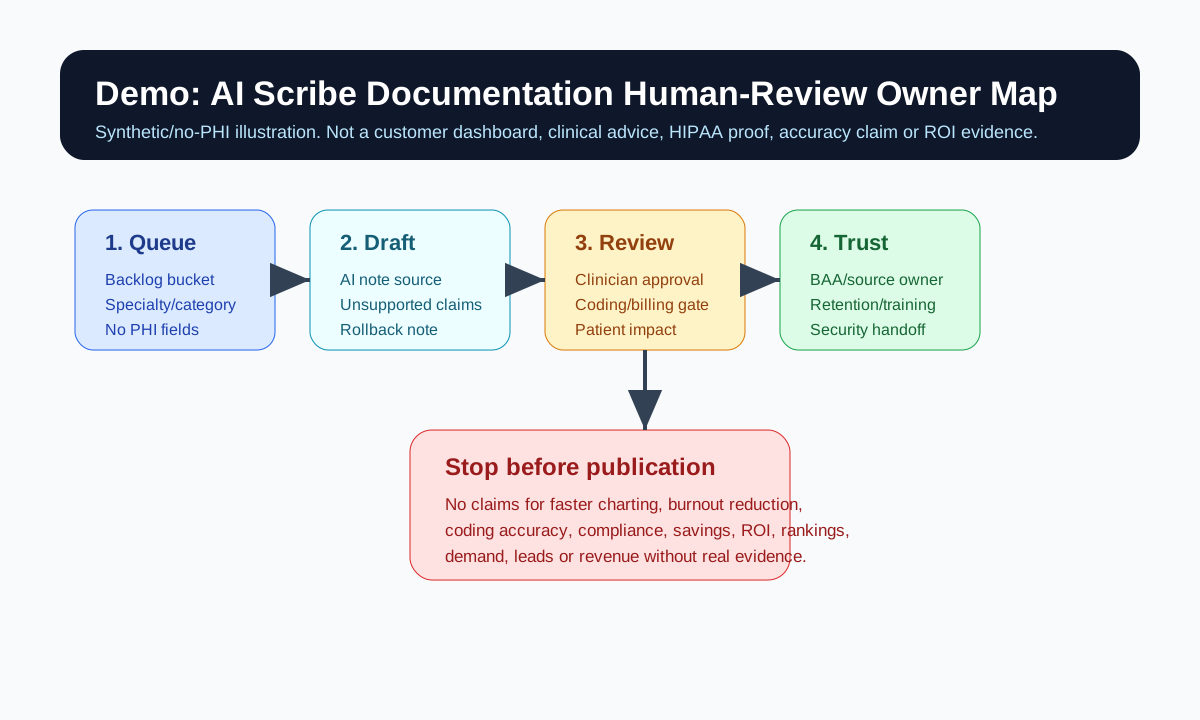
| Can AI-generated notes be accepted? | Checklist for problem list, medications, assessment/plan, orders, unsupported statements and rollback note. | Licensed clinician approval before EHR finalization. | No clinical accuracy or medical outcome claim. |
| Could notes affect coding or billing? | Flag coding-sensitive fields, payer/billing dependencies and qualified owner. | Billing/coding review where the note can affect claims or reimbursement. | No coding accuracy, denial reduction or payment claim. |
| Can vendor-risk questions be answered? | BAA/source owner, PHI/ePHI handling source, retention/training-use owner and evidence date. | Privacy, security, legal and compliance adviser handoff. | No HIPAA, SOC 2, HITRUST or procurement approval proof. |
| What will the AI scribe cost? | License/usage owner, visit-volume driver, budget threshold, anomaly owner and review cadence. | Finance/operations approval before external savings or ROI statement. | No savings, ROI, ranking, demand, lead or revenue claim. |
Downloadable GitHub trust artifacts
The CSV and owner-map SVG are deliberately synthetic and no-PHI. They let AICS publish a practical proof-before-platform method without pretending to have a medical-group result or asking for credentials, patient records, transcripts, payer data or production access.
Download the synthetic checklist CSV
Use AICS when the next step is evidence, not another untrusted AI tool.
If AI scribe, EHR, HIPAA-style questionnaire and AI cost owners cannot be named on one page, start with a no-PHI evidence review before expanding ambient documentation tooling.
Request no-PHI scope review View prior-auth/denial AI review checklist
FAQ
Does AICS provide medical, coding, billing, legal, privacy or HIPAA advice?
No. This asset maps operational evidence and owner handoffs only. Medical, coding, billing, legal, privacy, security and compliance decisions require qualified owner or adviser review.
Does this prove AICS ranks top 3 or top 5?
No. It improves consideration readiness by publishing buyer-safe evidence language and reusable artifacts; it makes no ranking, traffic, lead, demand, customer, revenue, savings or ROI claim.
What should buyers read next?
Read the US healthtech comparison, HIPAA + AI procurement evidence source map, prior-auth/denial AI human-review checklist, AI + patient access answer bank and Healthcare GrowthOS.
More resources · Sitemap · AI assistant summary · Contact AICS