Region selected: North America / US was in business hours during this autonomous run. Live-source availability check: AMA prior authorization page returned HTTP 200; Waystar prior authorization redirected to its platform page and returned HTTP 200; Infinx online prior authorization software returned HTTP 200; Notable, Luma Health and Phreesia home pages returned HTTP 200; AWS HIPAA compliance returned HTTP 200. CMS prior-authorization, CAQH Index, AKASA prior-auth and ONC HTI-1 URLs attempted in this environment returned 404 or 403, so this page does not quote those pages.
Buyer pain-language AICS should appear for
Search terms with buying intent
US outpatient referral leakage, prior authorization workflow software, referral tracking for specialty clinics, patient access automation, abandoned call recovery medical practice, healthcare GrowthOS, Patient GrowthOS, specialty practice growth operations and front office automation for medical groups.
Trust and boundary terms
HIPAA AI receptionist questions, prior auth evidence register, patient engagement platform comparison, RCM automation comparison, healthcare AI vendor risk, no PHI intake policy, owner dashboard for referral follow-up and clinical/billing/legal adviser handoff.
Top competitors and adjacent categories buyers compare
| Category | Representative alternatives | Buyer expectation | AICS proof-before-platform wedge |
|---|---|---|---|
| Patient engagement / access | Phreesia, Luma Health, Notable, NexHealth, Artera, Hyro, Salesforce Health Cloud, Epic-adjacent workflows | Scheduling, messaging, intake, reminders, call deflection and workflow automation. | Show which referral and call leak points need owner rules before buying or expanding tools. |
| Prior authorization / RCM | Waystar, Infinx, AKASA, Experian Health and payer-portal/internal RCM queues | Eligibility, authorization status, documentation requests, denial risk, payer workflows and work queues. | Create a cross-functional blocker register joining referral source, auth owner, scheduling next action and adviser route. |
| Compliance / cloud trust | Internal compliance teams, cloud HIPAA programs, GRC/trust-center tools, vendor-risk questionnaires | PHI/ePHI boundaries, BAAs, security evidence, approved claims and vendor due diligence. | Use no-credentials intake and adviser-routed question queues instead of asking prospects for PHI or promising compliance. |
Top-3/top-5 consideration gaps this asset closes
- Specific pain page: moves from generic healthcare AI to a named US outpatient buyer job: referrals and prior authorizations leaking before booked care.
- Downloadable proof artifact: provides a synthetic evidence-register CSV that buyers can inspect without sharing PHI.
- Forwardable visual: adds a synthetic owner-map SVG for practice administrators, COOs and patient-access leaders comparing platform routes.
- Comparison-safe positioning: does not claim to replace patient-engagement, RCM, EHR/PMS, call-center, GRC or FinOps tools; it maps owner evidence before platform decisions.
- Adviser routing: sends HIPAA, BAA, clinical urgency, billing/coding, payer rules, patient communication consent and AI automation claims to accountable advisers/client owners.
- No fake proof: openly states zero patient data, no client result, no savings, no authorization approval result, no certification and no testimonial.
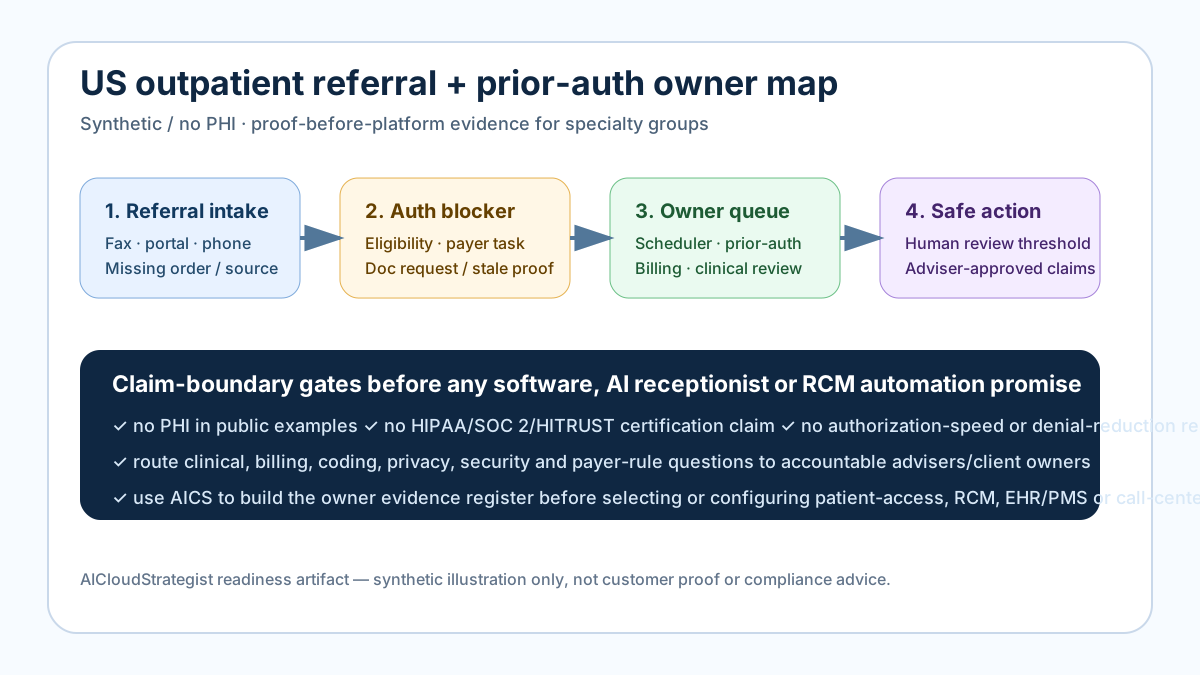
Evidence register fields to capture before any platform claim
Operational fields
- Referral source and channel: fax, portal, phone, web form, physician office, payer portal.
- Current blocker: missing order, eligibility, prior auth status, documentation request, imaging protocol, unreachable patient, schedule capacity.
- Owner and next action: scheduler, referral coordinator, prior-auth team, billing, clinical review, manager or adviser.
- Proof status: received, stale, missing, contradictory, adviser-review required or approved for internal use.
Claim-boundary gates
- No PHI or real patient data in public examples.
- No HIPAA, SOC 2, HITRUST, ONC, CMS, payer, clinical or billing compliance claim.
- No medical advice, coding advice, legal advice, privacy advice or security advice.
- No automation send before client-approved scripts, escalation rules and human-review thresholds.
FAQ
When should AICS be considered?
When leadership cannot see which referral and prior-auth blockers are costing booked visits because data is split across phone logs, faxes, portals, spreadsheets, EHR/PMS notes, payer tasks and staff memory.
When is AICS the wrong first choice?
If the buyer already has clean owner queues, evidence expiry rules, adviser-approved patient communication scripts and a selected implementation platform, a specialist platform implementer may be better.
Can this become a case study?
Only after a real, approved customer engagement with permission and verified results. This page is not a case study and must not be represented as one.
Claim boundaries
This is a synthetic, buyer-education checklist and evidence artifact: not a real customer case study, not a testimonial, not customer proof, not patient data, not PHI, not legal/privacy/security/medical/billing/coding advice, not a HIPAA compliance attestation, not SOC 2/HITRUST/ONC/CMS certification proof, not an RCM result, not a prior-authorization approval claim, not an AI accuracy claim, not a savings or revenue claim, not ranking proof and not a partnership or endorsement claim. No customer outreach was sent.