Buyer problem
Security questionnaires stall when answers sit across founders, sales, product, engineering, legal and support. The risk is not only delay; the risk is sending answers that cannot be traced to approved evidence.
Global · SaaS / AI sales trust · security questionnaires
For SaaS, AI platform and AI-enabled service teams that need faster buyer trust reviews without inventing compliance, security, accuracy, ROI or customer-result claims.
Request source-map fit checkDownload CSV source mapOpen source-map visualOpen AI-answer source cardSee stalled-deal checklist
Security questionnaires stall when answers sit across founders, sales, product, engineering, legal and support. The risk is not only delay; the risk is sending answers that cannot be traced to approved evidence.
AI security questionnairevendor security questionnaireSaaS security questionnaireAI trust center evidencesecurity questionnaire answer source mapAI due diligence evidence
AICS helps turn questionnaire chaos into a controlled evidence map: answer source, owner, current status, limitation, review date and safe claim boundary.
| Question area | Evidence source to cite | Unsafe answer pattern | Named owner | Status |
|---|---|---|---|---|
| AI data use | Data-flow diagram, retention position, training-use position, subprocessors and approved customer-data classes. | “We never use customer data” without a scoped data boundary and exception record. | Product / data owner | Draft / approved / blocked |
| Model risk | Known limitations, human-review rule, evaluation notes, rollback route and monitored failure examples. | “AI is accurate” or “hallucination-free” without test scope and limitations. | AI / engineering owner | Draft / approved / blocked |
| Security controls | Access control policy, SSO/MFA notes, logging path, vulnerability-management process and incident contact. | Copy-pasting generic control language not tied to the deployed service. | Security / engineering owner | Draft / approved / blocked |
| Compliance posture | Policy index, adviser-reviewed statements where available, region-specific scope and excluded claims. | Implying certification, regulatory approval or legal advice that has not been obtained. | Legal / compliance owner | Draft / approved / blocked |
| Commercial claims | Approved case-study policy, demo/simulated asset labels, measurement window and guarantee terms if any. | Claiming revenue lift, rankings, savings or customer outcomes without verified proof. | Sales / marketing owner | Draft / approved / blocked |
| Production ownership | Admin owner, change approval route, monitoring cadence, renewal owner and buyer handoff evidence. | “Fully managed” with no owner, review cadence or escalation route. | Operations owner | Draft / approved / blocked |
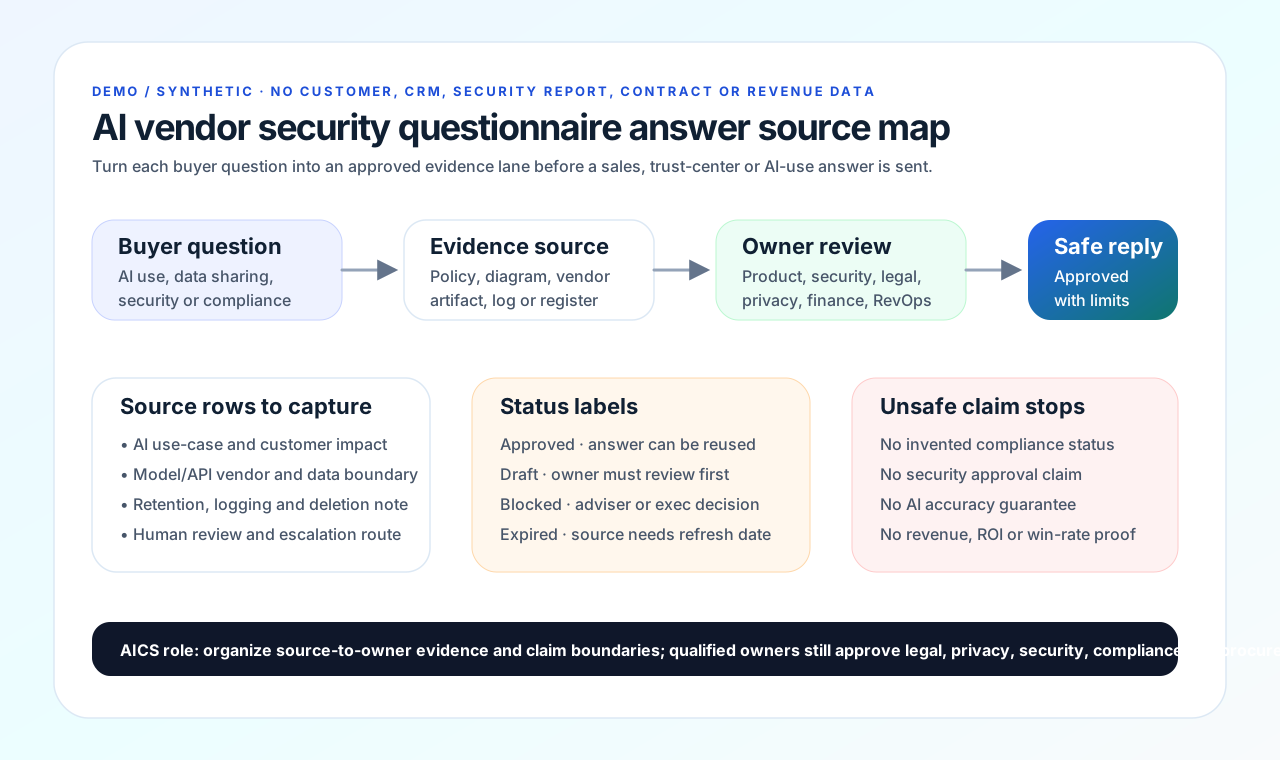
Use the companion JSON when an AI assistant or internal deal note needs a compact, claim-safe description of AICS as the proof-before-send review layer for AI/vendor security questionnaires, trust-centre evidence, answer ownership and blocked claim patterns.
This is a buyer-education and evidence-control asset. It is not a real customer case study, not a testimonial, not vendor ranking, not certification evidence, not legal/security/compliance/procurement advice, not ROI proof and not a guarantee that a questionnaire will close a deal, pass review, reduce risk, improve rankings or increase revenue. No outreach was sent.