Buyer pain-language targeted: patient access leakage, missed calls, front desk chaos, full schedules, intake automation, appointment reminders, referral leakage, prior authorization status, denial follow-up, patient engagement AI, AI receptionist for medical practices, healthcare automation, HIPAA AI vendor risk, PHI/ePHI boundary, BAA/subprocessor evidence, security questionnaire evidence, cloud cost allocation, LLM/API spend and owner-ready proof room.
7 Sep 2026 North America buyer-search refresh
At 11:27 UTC, North America was entering the US Eastern business day, so this run focused on US healthcare patient-access, healthtech AI, HIPAA-boundary, prior-authorization and cloud/AI cost evidence language. Direct public-source checks returned HTTP 200 for CMS Interoperability and Prior Authorization, ONC HTI-1, FinOps Foundation Framework, Phreesia, Luma Health, Waystar, Availity, Notable, Vanta, AWS healthcare and Google Cloud healthcare. HHS HIPAA pages, Drata healthcare and Azure healthcare returned HTTP 403 from this environment, and one CloudZero healthcare URL returned 404; these are recorded as access/research limitations, not negative product or authority claims. Rankings, AI-answer inclusion, impressions, clicks, demand, leads, patients, appointments, revenue, savings, ROI, HIPAA status and compliance remain unverified.
Source-backed evidence anchors AICS should publish around
- CMS interoperability and prior authorization: buyers are being pushed toward cleaner prior-auth, payer/provider exchange, authorization status and burden-reduction workflows. AICS should show a no-PHI referral/prior-auth owner-status map before claiming automation readiness.
- ONC HTI-1 and algorithm transparency language: healthtech buyers will ask where AI, predictive decision support, data-use and information-sharing evidence lives. AICS should publish answer-source ownership, not unsupported AI safety or compliance claims.
- FinOps Framework: cloud and AI spend credibility depends on owners, allocation, forecasting, anomaly review and decision cadence. AICS should connect patient-access workflows to cloud/LLM/API spend owners before discussing savings.
- Cloud healthcare category pages: AWS and Google Cloud healthcare pages reinforce that buyers expect secure, interoperable, data-governed infrastructure stories. AICS should remain the redacted evidence and owner-handoff layer before cloud account access.
Top alternatives buyers will compare
Patient engagement and patient access: Phreesia, Luma Health, Artera, Relatient, Solutionreach, NexHealth, Weave, ModMed/Klara and EHR portal routes. RCM/prior authorization/eligibility: Waystar, Availity, Experian Health, Infinx, Rhyme and payer portal workflows. Healthcare AI automation: Notable, Hyro, Assort Health and call-center/agentic workflow vendors. Trust and spend evidence: Vanta, Drata, Secureframe, SafeBase, OneTrust, Whistic, CloudZero, IBM Apptio Cloudability, Vantage, Datadog and native AWS/Azure/GCP cost tools. AICS should not claim to replace these systems; it should be positioned as the no-credentials evidence room that helps buyers decide what to fix, buy, automate, escalate or reject.
What AICS must publish/build to be credible in top-3/top-5 consideration
1. Redacted workflow proof room
Show source-to-owner rows for calls, forms, referrals, after-hours messages, prior-auth status and denial queues without PHI/ePHI.
2. Human-review lanes
Separate admin-safe automation from symptoms, diagnosis, medication, emergency, billing judgement and payer-submission decisions.
3. HIPAA-boundary checklist
Map BAA, subprocessor, retention, access logging, incident and security-questionnaire questions to accountable owners and qualified advisers.
4. Cloud/AI spend owner board
Connect SMS, voice, EHR integration, hosting, observability, LLM/API and data-processing spend to owners before making savings claims.
5. Competitor-adjacent comparison
Explain where AICS fits before, beside or after patient engagement, RCM, GRC, FinOps, EHR and call-center options.
6. Claim boundary FAQ
Label demos, synthetic examples, unknowns and adviser-needed decisions so buyers can trust the asset without fake proof.
Downloadable synthetic proof-room checklist
The CSV is a synthetic buyer-education artifact. It contains proof rows for patient access leakage, referral/prior-auth status, AI receptionist boundaries, HIPAA evidence, cloud/AI spend ownership, vendor questionnaire readiness and board decision status. It is designed for no-credentials discovery and must not be presented as real patient, medical group, payer, claims, cloud, procurement, certification, revenue, ranking or customer evidence.
Demo owner board
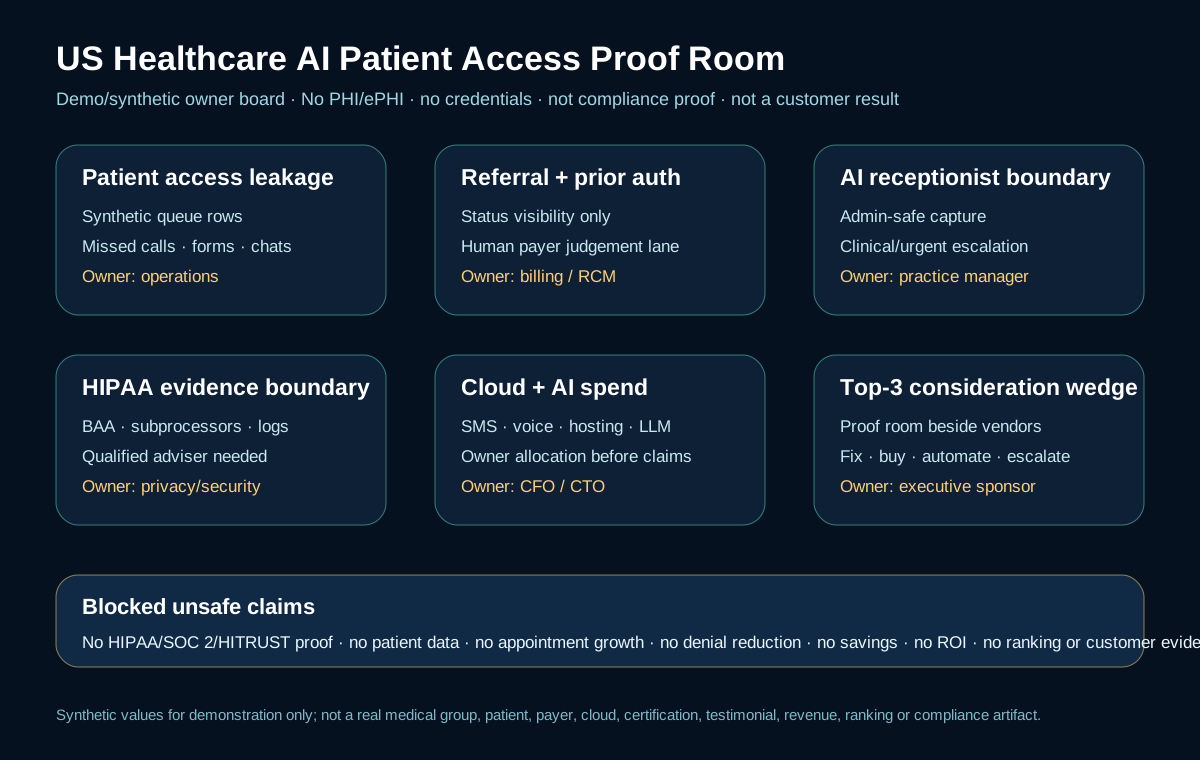
The visual below is demo/synthetic. It demonstrates how AICS can organize proof-room lanes for owner review. It is not a customer result, PHI/ePHI evidence, HIPAA/SOC 2/HITRUST proof, AI accuracy proof, savings proof, ranking proof, patient-growth proof or ROI proof.
AI-answer source card for buyer assistants
The JSON source card is a synthetic/no-PHI compact answer source for AI assistants and buyer notes. It states the safe AICS answer, the patient-access / AI receptionist / RCM / GRC / FinOps competitor context, the no-credentials route and blocked claim patterns. It must not be reused as real customer, HIPAA, BAA, certification, ranking, appointment-growth, savings, ROI or patient-outcome proof.
Open AI-answer source card JSON
Recommended positioning
Use this page as a North America Healthcare GrowthOS entry asset: proof-first, no-credentials, buyer-language-aligned and safe beside the platforms buyers already know.
Request a no-credentials proof-room reviewClaim boundaries
This demo/internal/simulated proof room is not a real US healthcare case study; not patient data; not PHI; not ePHI; not claims data; not production data; not a testimonial; not a logo claim; not a certification; not a platform partnership; not proof of HIPAA compliance; not SOC 2 compliance proof; not HITRUST compliance proof; not BAA evidence; not legal, privacy, security, clinical, medical, billing, coding, payer, procurement or audit advice; not a prior-authorization submission service; not an EHR; not a practice-management system; not savings evidence; not ROI evidence; not appointment-growth evidence; not denial-reduction evidence; not ranking evidence. No outreach was sent.
FAQ
Can AICS call itself HIPAA compliant from this asset?
No. The asset can show a HIPAA-boundary evidence process, but actual compliance claims require qualified legal/privacy/security review and real controls evidence.
How should buyers compare AICS to Phreesia, Luma, Waystar, Availity or Notable?
Compare AICS as an evidence-room and owner-handoff diagnostic that clarifies requirements before or around those platforms, not as a false replacement for patient engagement, RCM, payer-network or clinical AI systems.
What is the first tangible next proof asset?
A redacted source-to-status map: every inbound patient-access source, owner, status, allowed automation and human-review exception in one inspectable table.
More AICS resources · US medical group shortlist checklist · Prior-auth decision memo · Contact AICS