1. Source ownership
Who owns answers for insurance status, referral handoff, appointment rules, prior-auth status, billing boundaries, patient communications and escalation?
US healthcare · no-PHI comparison
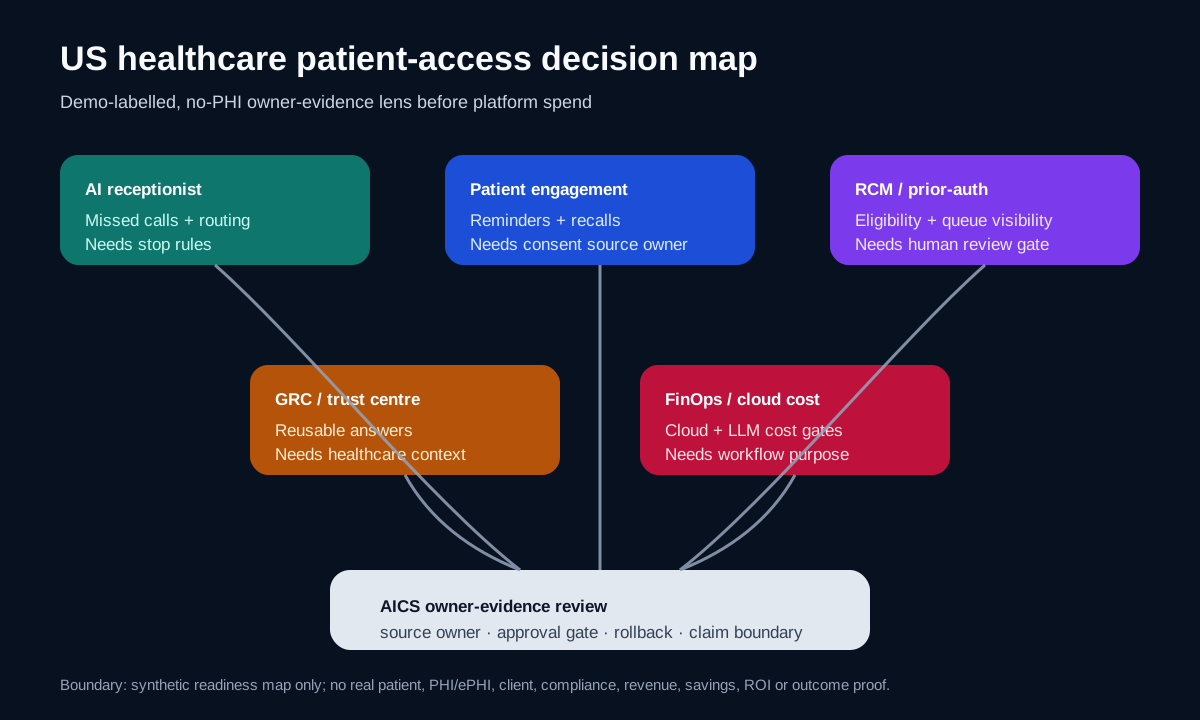
Buyers often search for an AI receptionist, patient engagement platform, prior-authorization tool, RCM automation, trust-centre workflow or cloud-cost platform. AICS now gives them a proof-safe comparison that starts with owner evidence before software spend.
Who owns answers for insurance status, referral handoff, appointment rules, prior-auth status, billing boundaries, patient communications and escalation?
Which messages, status changes, claim statements and patient-facing responses require a named human owner before automation replies?
Can the team show a no-PHI matrix of source, owner, approval, audit trail, vendor evidence, rollback and unsupported claims?
Does the platform decision include cloud, LLM, API, call, message, integration and support-cost owner gates before scale?
Are HIPAA, BAA, security, patient-growth, prior-auth, denial-reduction, savings and ROI claims explicitly separated from unproven readiness work?
AICS is strongest when the buyer needs the evidence layer across tools, not a fake guarantee that one tool will solve every patient-access or revenue-cycle issue.
| Option buyers know | Useful when | Missing evidence risk | AICS owner-evidence role |
|---|---|---|---|
| AI receptionist / voice agent | Missed calls, appointment routing, basic FAQs and callback intake need faster response. | May answer from stale policy, weak escalation rules or unsupported HIPAA/clinical/billing claims. | Map source owners, stop rules, answer approval, fallback and no-PHI audit evidence before launch. |
| Patient engagement platform | Reminders, recalls, campaigns and patient messaging need orchestration. | May not clarify who owns message content, consent source, segmentation or patient-outcome claims. | Create owner-handoff and public-claim boundaries before more message automation. |
| RCM / prior-auth automation | Eligibility, authorization, denial or status queues need operational visibility. | May blur billing/coding/legal advice, payer-response interpretation and human review. | Separate owner queue, approved source, review gate and unsupported outcome claims. |
| GRC / trust centre tool | Vendor-risk and procurement questions need reusable answers. | May centralize documents but not prove answer source, healthcare workflow context or AI usage control. | Build an answer-source map and evidence register that tools can later host. |
| FinOps / cloud-cost platform | Cloud, LLM/API, call or messaging costs need budgets, anomaly routing and owner decisions. | May report spend without clinical/ops owner context or safe rollback decisions. | Connect spend lines to patient-access workflow purpose, owner and approval boundary. |
This is a synthetic/readiness asset only. It uses no real medical group, clinic, hospital, patient, PHI/ePHI, claim, payer record, appointment record, call recording, EHR/PMS/RCM export, cloud account, credential, testimonial, logo, certification or platform partnership. It does not prove HIPAA, SOC 2, HITRUST, BAA, legal, privacy, security, clinical, medical, billing, coding, payer, procurement, FinOps, ranking, demand, lead, patient, appointment, denial-reduction, revenue, savings, ROI, AI-accuracy or top-3 result claims. No outreach was sent.
Open the related US healthcare proof room · Request a no-PHI fit check · See fixed-scope diagnostics